

Cover photo: Flickr. Paul van der Werf
Without a doubt, you have to cross Seville’s most famous bridge to reach this neighborhood you’ve heard so much about. In movies, TV shows, and sevillanas… the name Triana has come up more than once.
The birthplace of flamenco, a home to sailors, and a center for pottery all come together in Seville’s most distinctive neighborhood.

Triana: Across the Bridge, A World Apart
Triana lies on the other side of the river, and for many centuries it lay outside the city walls, connected to the city only by a bridge made of wood and small boats called the “puente de barcas.” As a result, it developed its own unique character.
It is the neighborhood of flamenco, since the Romani people have lived in Triana since the 15th century; the neighborhood of ceramics, as artisans had their workshops here, which became famous throughout European kingdoms; and the neighborhood of sailors, as captains, pilots, and seamen lived here on the riverbank. That is why its most famous and most revered Virgin is the Esperanza de Triana, housed in the Chapel of the Sailors (Capilla de los Marineros).
As soon as you cross the bridge, it becomes clear that you’re in a different part of Seville—perhaps the more traditional and local one—far from the tourist hustle and bustle of the historic district. And this is something you should keep in mind from the start: you won’t find any major monuments in Triana; the point is to stroll around and soak up its essence—not just that of Seville, but specifically that of Triana.

Walking:
Triana invites you to take a stroll, as that’s the only way to discover the best it has to offer. As soon as you cross the Triana Bridge (actually called the Isabel II Bridge), you’ll arrive at Plaza del Altozano, with its regionalist-style buildings, the Carmen Chapel, and the food market, which has now been partially converted into a gourmet market. Stroll down the pedestrian-only Calle de San Jacinto and explore Calle San Jorge and Calle Alfarería if you’d like to learn more about this art form. On Castilla Street, you’ll find historic communal courtyards like the Corral de las Flores, and after passing through Callejón de la Inquisición, you’ll reach the lovely Paseo de la O, where you can view the Triana Bridge from below and where you’ll find a local craft market on Sunday mornings.
But to get to Santa Ana Church, you’ll have to stroll down the quiet Calle Pureza, and, if you feel like it, grab some tapas at one of its small shops. Finally, a must-see is the famous Calle Betis, right by the river, where you can sit down for a drink and enjoy beautiful views of the Guadalquivir.


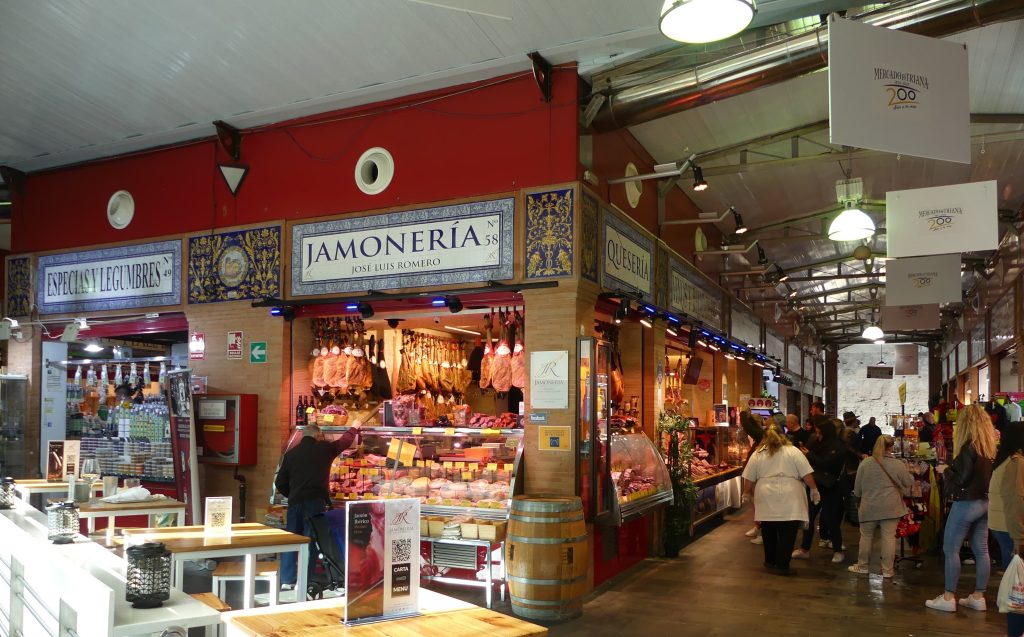
Photos: top left: Flickr Sandra Vallaure; top right: Flickr. Ajay Suresh; botton: wikipedia
What to see:
Churches
Santa Ana
Chapel of Sailors
Museums
Triana Ceramics Center
Saint Jorge Castle
⭐
Highlight: Don’t miss…!
The Chapel of Carmen, designed by Aníbal González (the same architect who designed Plaza de España), is one of Triana’s landmarks. Even the people of Triana still cross themselves when they walk past it.
❓
Secret place: Did you know…?
The former Casa Mensaque is a spectacular traditional Sevillian house adorned with various types of ceramic tiles, as its owners ran one of the most renowned ceramic factories. Today, it’s the Triana District Office
How about a tour around Triana?
Why not explore Triana in depth and fall in love with this very special neighborhood? Triana has its own unique charm, but there’s nothing quite like a guided tour to uncover all its secrets. Book your tour with me!
more areas of seville

Historic Centre
Cover photo: Flickr. Eric Cooper The largest in Spain and one of the largest…
27 de May de 2020
Santa Cruz Quarter
Cover photo: Wikipedia Seville’s most charming neighborhood, the one most often written about and…
18 de August de 2026
Triana Quarter
Cover photo: Flickr. Paul van der Werf Without a doubt, you have to cross…
18 de August de 2026
El Arenal Quarter
Cover photo:gavilansevilla Its name comes from the fact that the area historically had sandy…
18 de August de 2026
Alameda – Macarena
Cover photo: TRAVELER Tradition and bohemian modernity go hand in hand in this neighborhood…
18 de August de 2026
Maria Luisa Park and surroundings
Cover photo: Flickr. Jocelyn Erskine-Kellie Just outside the city walls near the Puerta de…
18 de August de 2026