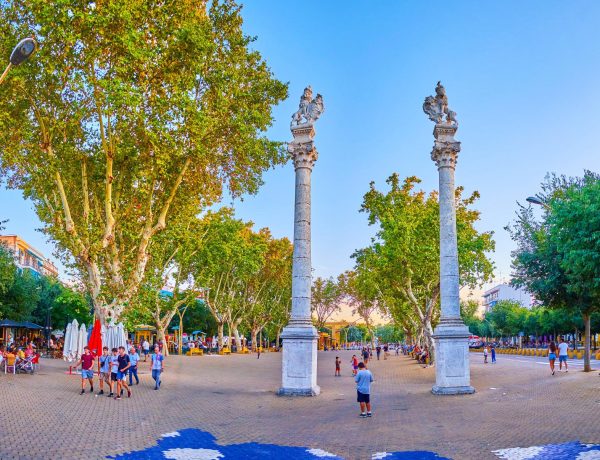
Cover photo: Wikipedia
Seville’s most charming neighborhood, the one most often written about and praised in verse. And precisely for that reason, it’s most likely to be full of tourists. But this shouldn’t spoil our stroll, since there are so many beautiful spots here that its charm prevails anyway.
Famous for its narrow, labyrinthine streets, this is the neighborhood of Carmen, home to Don Juan Tenorio, Washington Irving, and the Barber of Seville, but also the former Moorish and Jewish quarters, all renovated for the 1929 World’s Fair.
The Jewish Quarter
Originally built as an exclusive neighborhood for the Muslim upper class, it became a Jewish quarter following the Christian conquest, which is why many still refer to it as such, even though it ceased to function in the 15th century and became a neighborhood for Seville’s Christian aristocracy.
However, the Jewish quarter actually covered a larger area than what is now the Santa Cruz neighborhood itself; but for the 1929 Ibero-American Exposition, it was renovated and adapted for visitors, bringing together all the Sevillian charm and folklore it offers today.

Walking:
It is characterized by a network of labyrinthine and intricate streets, where it’s easy to get lost, but also to be enchanted by its colors, scents, and the many hidden plazas and courtyards.
Stroll down Calle Vida and Calle Muerte, two parallel streets with completely different histories, and discover the legend of La Susona, whose tile depicting her skull attracts thousands of visitors. Walking down Calle Pimienta you’ll reach Callejón del Agua, with the Alcázar wall on one side—through which water once flowed into the city. As a fun fact, the narrowest street in Seville is Calle Reinoso, but it’s known as “Calle del Beso” (Kiss Street), since the balconies are so close together that neighbors could kiss each other. Finally, Calle Cruces has a funny anecdote behind it, and Calle Lope de Rueda is very Instagram-worthy.


Photos, from left to right: gavilansevilla; Flickr: Jocelyn; gavilansevilla.
This neighborhood has no shortage of squares, and each one has its own special charm: Plaza de Doña Elvira is the most famous, but don’t miss the Plaza de Santa Cruz, named after the church of that name that no longer stands, where you’ll see a 16th-century wrought-iron cross in the center; or the Plaza de Alfaro, famous for Rosina’sbalcony (from the opera The Barber of Seville) and for the “Devil’s iron window grille,” so named because the complex process used to create it remains a mystery. Also worth visiting are the Plaza de los Refinadores, on the “outskirts” of the neighborhood, and the Plaza de los Venerables, where you’ll find the Hostería del Laurel (the setting for the first scene of the play Don Juan Tenorio) and the Hospital de los Venerables, a must-see.


Fotos de gavilansevilla
What to see:
Monuments
Hospital de los Venerables
Palaces
Casa Salinas
Churches
Santa María la Blanca
⭐
Highlight: Don’t miss…!
The small section of the Jewish quarter’s wall, located on Fabiola Street. If you’re not looking for it, it goes unnoticed, so be sure to take a close look at the only remnant of this wall.
❓
Secret place: Did you know…?
Inside the Cano y Cueto parking garage, there is a Jewish coffin. The Jewish cemetery was discovered during construction of the parking garage in the 1990s, and this coffin is the only remnant of that site.
How about a tour around the Santa Cruz Quarter?
Want to explore the Santa Cruz neighborhood in a unique way? Book your tour with me!
Before booking my tours, you might want to get to know me better here. I’m a historian and certified tour guide with years of experience, and I’ll share the history with historical accuracy but also with a personal touch and entertaining fun facts.