

Cover photo: Flickr. Eric Cooper
The largest in Spain and one of the largest in Europe. The Old Town is considered to be everything that was located within the city walls. However, since it is so large, it is usually divided into other areas such as Santa Cruz, El Arenal, and Alameda-Macarena.
For that reason, here I’m going to focus on the historic center—Seville’s monumental and commercial district: the city’s best-known area and also the most visited by tourists.
Highlights: Historic District

As in most cities, it encompasses the area surrounding the cathedral, except that in this case we are referring to the complex of the Real Alcázar, the Cathedral, and the Archivo de Indias, which were designated a UNESCO World Heritage Site in 1987. These monuments are located between the Virgen de los Reyes and Triunfo squares.
Como en la mayoría de las ciudades, abarca los alrededores de la Catedral, sólo que en este caso hablamos del conjunto Real Alcázar, Catedral y Archivo de Indias, declarados como Patrimonio de la Humanidad por la UNESCO en 1987. Estos monumentos se localizan entre las plazas Virgen de los Reyes y Triunfo.
Walking:

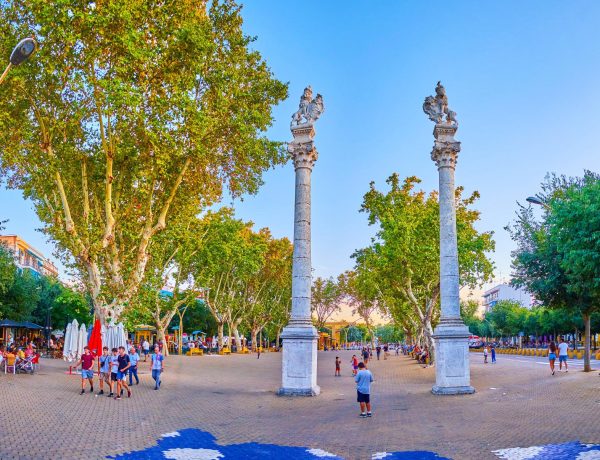
The entrance (or exit) to the historic center is the famous Puerta de Jerez, a beautiful square that still bears its name even though the actual gate no longer exists; from there, the route continues along Avenida de la Constitución, lined with regionalist-style buildings and with the Cathedral’s facade on one side. You’ll arrive at the beautiful La Adriática building, next to Town Hall, whose Plateresque facade faces Plaza de San Francisco, the heart of the city in the 16th century.


Buildings in Avenida de la Constitución. Top: Flickr. Gary Campbell-Hall. Botton left: Wikipedia; botton right: Flickr. Paul VanDer Werf
From there, you can take a leisurely stroll down the famous Calle Sierpes, lined with well-known brands, or wander down Calle Francos, known for its traditional shops. Don’t miss Calle Cuna, with its Ciudad de Londres building and the Casa de la Condesa de Lebrija.
As for squares, there are a lot of them, but the most famous ones are Plaza del Salvador—where Sevillians enjoy their customary beer—Plaza del Pan, Plaza de la Pescadería and Plaza de la Alfalfa, the latter teeming with tapas bars.
In the area, you’ll also come across La Campana, famous for its traditional pastry shop, and Las Setas, a true symbol of modern Seville that’s a must-see.


Photos, from top left to botton right: Flickr. Eric Cooper, Sandra Vallaure, Pablo Alonso, Paul van der Werf, Pablo Alonso, gavilansevilla.
What to see:
Monuments
Town Hall
Las Setas
Palaces
Casa Pilatos
Casa Condesa de Lebrija
Churches
Salvador
Magdalena
Sights
Cabildo Square
Roman colums in Marmoles St.
Museums
Fine Arts
Antiquarium
⭐
Highlight: Don’t miss…!
The Church of San José (Saint Joseph): a small church tucked away on Sierpes Street, was built by the carpenters’ guild and is a prime example of Baroque architecture.
❓
A secret place: Did you know…?
Plaza de Santa Marta is one of the most hidden and charming squares in Seville. Its name comes from the former Santa Marta Hospital, and the cross that adorns the square dates back to the 16th century.
How about a tour of the Historic District?
Would you like to discover Seville’s most important landmarks with a professional guide? Book your “Essential Seville” tour with me:
Would you rather discover those hidden spots that don’t appear in guidebooks and get a taste of local life along the way? Then the “Unknown Seville” tour is perfect for you:
Or maybe you’d like a personalized tour? You can choose how many hours you want your tour to last and what you’re most interested in seeing:
Before booking my tours, you might want to get to know me better here. I’m a historian and professional tour guide with years of experience, and I’ll share the history with historical accuracy but also with a personal touch and entertaining fun facts.


No Comments