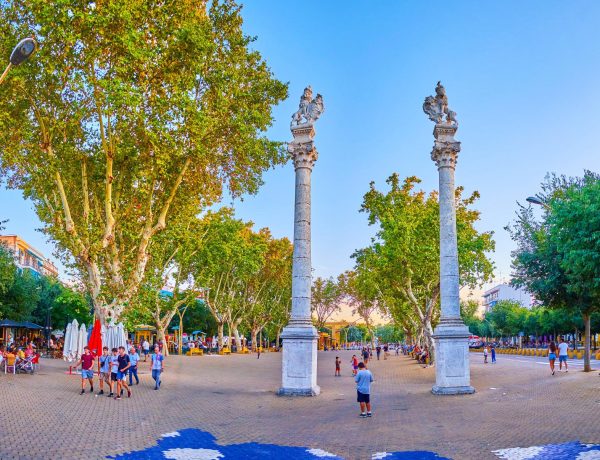
Cover photo: Flickr. Jocelyn Erskine-Kellie
Just outside the city walls near the Puerta de Jerez, south of Seville, stood two large buildings: the Royal Tobacco Factory and the San Telmo Palace, with its vast gardens. But this area was changed forever by an event that marked a turning point in Seville’s history: the 1929 Ibero-American Exposition.

The Expo ’29 Venue
Although Expo ’92 sounds much more familiar to us, the one in ’29 was actually just as impressive; Seville dressed up in its finest to welcome visitors from all over the world, aiming to become a city open to international tourism. The chosen location was the area surrounding María Luisa Park, which had been owned by María Luisa Fernanda de Borbón (sister of Queen Isabel II) along with the San Telmo Palace. María Luisa had bequeathed her private gardens to Seville—hence the park’s name—and they served as the epicenter of the event.


Photos. left: Universidad de Sevilla; center: Marriot; right: Wikipedia
Today, the area is a very pleasant place to stroll, where you can still see the pavilions of the different countries that participated, the most famous of which is the Spanish Pavilion (Plaza de España). Of course, the luxurious Hotel Alfonso XIII—also built for the exposition—catches the eye; it’s impossible to miss. And, a short distance from the city center, behind Plaza de España, lies the Porvenir neighborhood, where you can see houses from the 1920s designed in that distinctive historicist style..


Photos. left: casa de la ciencia; center: gavilansevilla; right: Wikipedia
Walking:
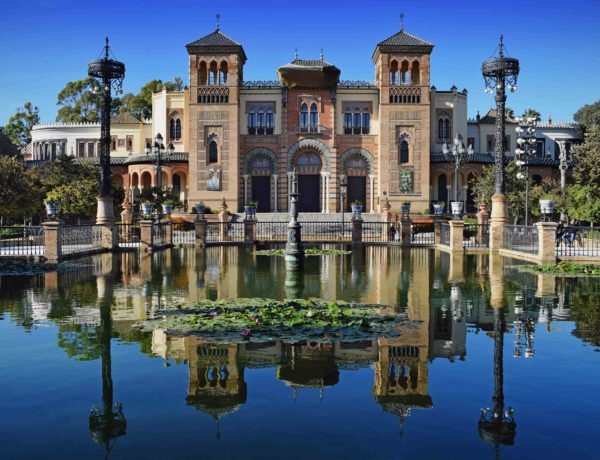
San Fernando Avenue connects the historic center with the park; it’s lined with places to grab a drink, especially to satisfy the students and faculty of the main building located there: the University of Seville, formerly the Royal Tobacco Factory. Afterward, you can’t leave Seville without visiting María Luisa Park, which is the city’s largest and most beautiful park, filled with fountains, small monuments, and little islands where birds and ducks gather… a must-see par excellence. You’ll arrive at Plaza de América, home to beautiful buildings such as the Museum of Popular Arts and Traditions and the Archaeological Museum. Next to it, on the Paseo de las Delicias, you’ll find the pavilions of the Ibero-American countries, such as those of Argentina, Brazil, Mexico, Colombia, and Morocco; and, heading back toward the city center, those of Peru, Chile, Uruguay, and Portugal. Oh, and you can head down to the riverfront promenade, the Muelle Nueva York, which always has a lively atmosphere, especially on spring and summer evenings.


Photos. From top left to botton right: gavilansevilla, Flickr: Mal B, Gary Campbell-Hall, Tony Hisgett
What to see:
Monuments
Plaza de España
University
Saint Telmo Palace
Sights
The Queen’s Sewing Place
Expo ’29 Pavilions”
Museums
Archaeological Museum
Museum of Popular Arts and Traditions
⭐
Highlight: Don’t miss…!
The Museum of Arts and Traditions, also known as the Mudejar Pavilion. Its facade is a marvel, designed by Aníbal González, the architect of Plaza de España. Its collection is very interesting.
❓
Secret place: Did you know…?
The Cervantes Roundabout depicts scenes from Don Quixote of La Mancha using the highest-quality tiles. It is a beautiful tribute to Cervantes and was conceived as an “open-air library”.